SEISMIC RESPONSE / VISCOUS DAMPERS / APPLE SILICON
Viscous dampers: compare the steel frame with and without one.
The same native DÈLGHEM D2 S355 portal is analysed twice under one synthetic ground-motion input. The mass, lateral stiffness and time step remain unchanged. The sole comparison variable is projected equivalent linear viscous damping, solved with the D2 reduced-order Newmark engine.
01 / TECHNICAL EVIDENCE
Which physical structure is represented?
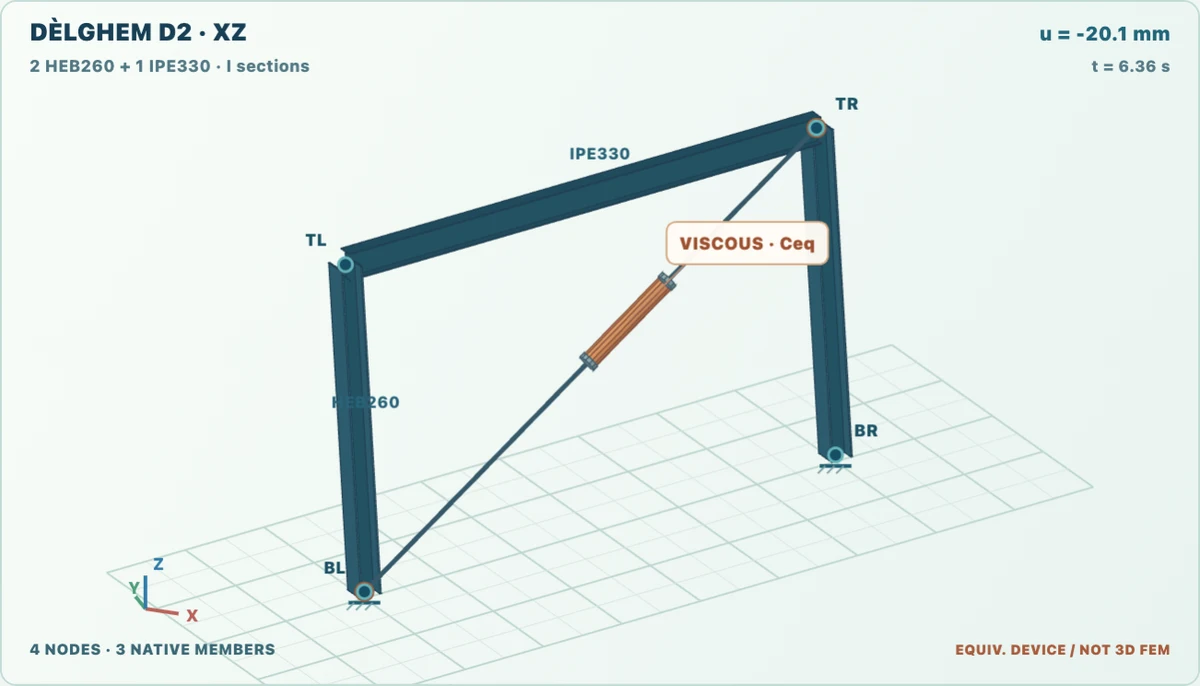
The authentic D2 input consists of a planar XZ portal with exactly four nodes, two HEB260 columns, one IPE330 roof beam, and two fixed bases. Physical web/flange sizes are read from the native steel section catalogue. The isometric view does not duplicate beams or columns behind the source frame.
Equivalent lateral stiffness is approximately 6813 kN/m, obtained by assembling a genuine two-dimensional Euler–Bernoulli frame stiffness matrix. A 28 tonne roof mass is assumed. The dynamic model is reduced to one generalized degree of freedom, not a fully integrated spatial building FEM.
02 / TECHNICAL EVIDENCE
One synthetic acceleration record, two genuine numerical histories
The displayed input is an analytic synthetic acceleration history, 18 s long, sampled at 0.01 s. It is not a recorded earthquake or a code-calibrated seismic design record. DÈLGHEM D2 solves each alternative with its native implicit Newmark MDOF engine, with 1801 time records per configuration.
For this particular benchmark, the roof displacement peak changes from 92.13 mm without damping device to 20.15 mm with its viscous equivalent: a 78.13% reduction for that specific input only. Both 3D overlays, their numeric readouts and the acceleration cursor share one time index.
03 / TECHNICAL EVIDENCE
Constitutive law and equivalent diagonal device
The damper law is F = C × sgn(v) × |v|^α. The reduced dynamic example uses α = 1 and C = 180 kN·s/m. The inclined element is projected into the lateral story degree of freedom using C equivalent = C × cos²θ.
The solved device dissipation is 23.24 kN·m. The current D2 seismic-device input contract accepts coincident connector endpoints. Thus the visible cylinder and brace are explanatory graphics of the equivalent term, not a direct verified three-dimensional Kratos viscous device joining remote beam nodes.
04 / TECHNICAL EVIDENCE
How to review results and their limits
The two histories are plotted together. Playback starts automatically once the section enters the viewport, pauses when the tab is hidden, and honours reduced-motion settings. The user can isolate either frame, inspect exact source geometry and access the benchmark data and corresponding numerical audit.
The comparison is not an NTC/Eurocode seismic certification, device qualification, or universal proof of a given damping benefit. Any interpretation for a real structure requires calibrated model properties, hazard-specific ground motion and full engineering verification.