GEOTECHNICAL / DÈLGHEM D2 / APPLE SILICON
Pile foundations and Winkler beams: inspect the engineering data.
DÈLGHEM D2 documents foundation pads, Winkler-supported grade beams and nonlinear axial pile benchmarks. Here the computed pile response is explicitly distinguished from the analytical proxy used to illustrate stress diffusion in layered soil.
01 / TECHNICAL EVIDENCE
Nonlinear axial pile response in two layered soil profiles
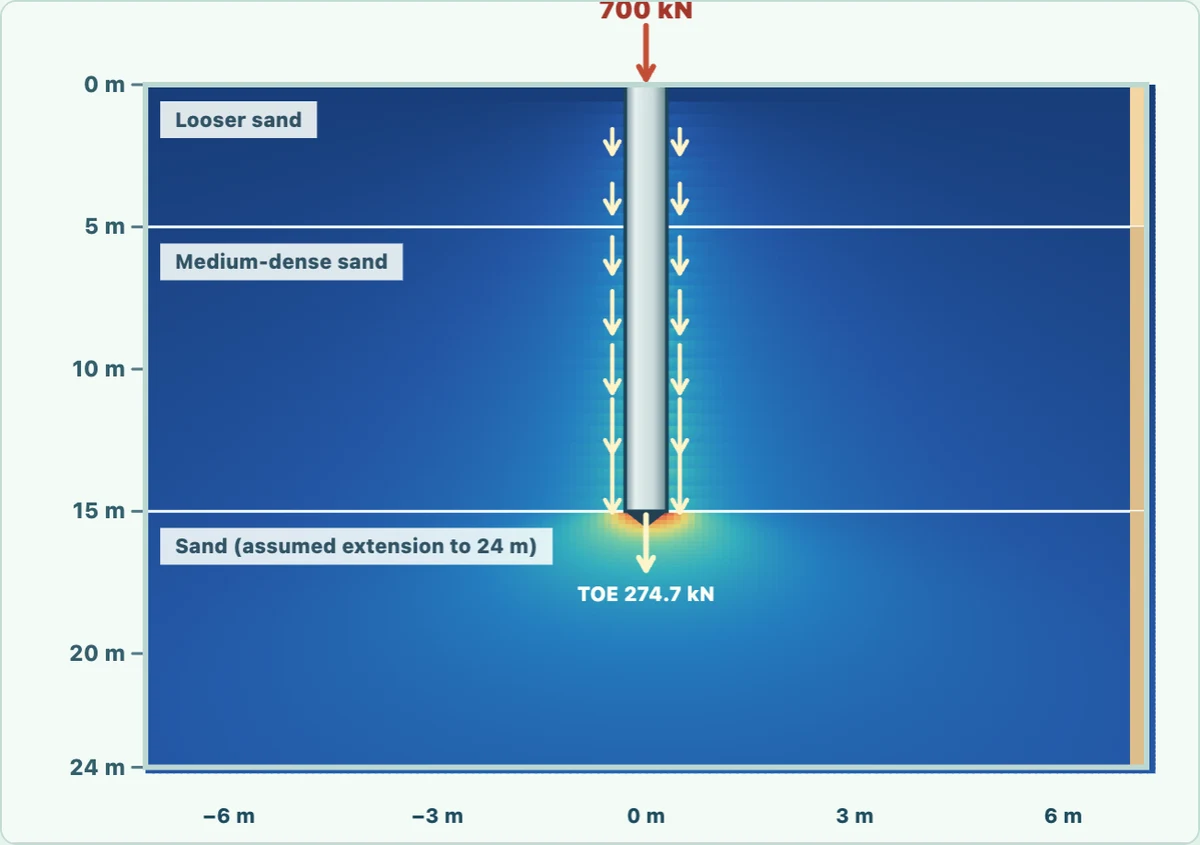
A 600 mm diameter, 15 m pile is subjected to a nominal 700 kN axial head load. The DÈLGHEM D2 t–z/q–z module solves a hypothetical layered sand profile with 5.943 mm head settlement, 425.3 kN shaft reaction and 274.7 kN mobilized toe reaction.
For a separately assumed layered clay profile the solved head settlement is 3.971 mm, with 660.9 kN along the shaft and 39.1 kN at the toe. Two distinct load–settlement curves and numerical force-balance audits are retained with the source data.
02 / TECHNICAL EVIDENCE
What the coloured soil stress section does—and does not—calculate
The effective lithostatic vertical stress σ′v,0 is a piecewise exact integral of the assumed effective unit weights through the declared soil layers. This arithmetic property is exact for those selected assumptions; it cannot establish site-specific soil characterization.
The additional Δσz load-spread contour is only a regularized analytic influence approximation based on the genuine D2 shaft and toe reaction sources. It is not a finite-element solution of the geotechnical continuum. Soil extending below the 15 m pile toe to 24 m is an illustrative assumption explicitly disclosed in the demonstration.
03 / TECHNICAL EVIDENCE
Native Winkler foundation models, connections and inspection
Two published DÈLGHEM geometric specimens illustrate supported grade beams: a sports canopy includes 16 Winkler foundation ties, while the timber terminal comprises 52 native D2 Winkler beams linking the pads. The geometrical elements and elastic support descriptions are authentic editable model inputs, not completed design checks.
The 3D foundation-only camera can isolate grade beams and pad positions, helping engineers inspect topology and restrained nodes. Foundation bearing resistance, group effects, differential settlement, and soil–structure interaction require engineering input and verification beyond the demonstrated model geometry.
04 / TECHNICAL EVIDENCE
Sources, engineering limitations and release status
Actual nonlinear D2 axial benchmark inputs, SHA-256 source fingerprints and plot datasets are published in the official engineering evidence directory. The pile axial solver is a separate numerical domain from Kratos structural-shell FEM, and the site states this distinction directly.
No subsurface investigation, in-situ validation, NTC geotechnical ULS/SLS approval or full constructed-structure certification is claimed. DÈLGHEM vAlpha1 remains in development for Apple Silicon macOS.