GENIUS ASSISTANT / APPLE SILICON / FEM
Genius Assistant: from an instruction to an inspectable model edit.
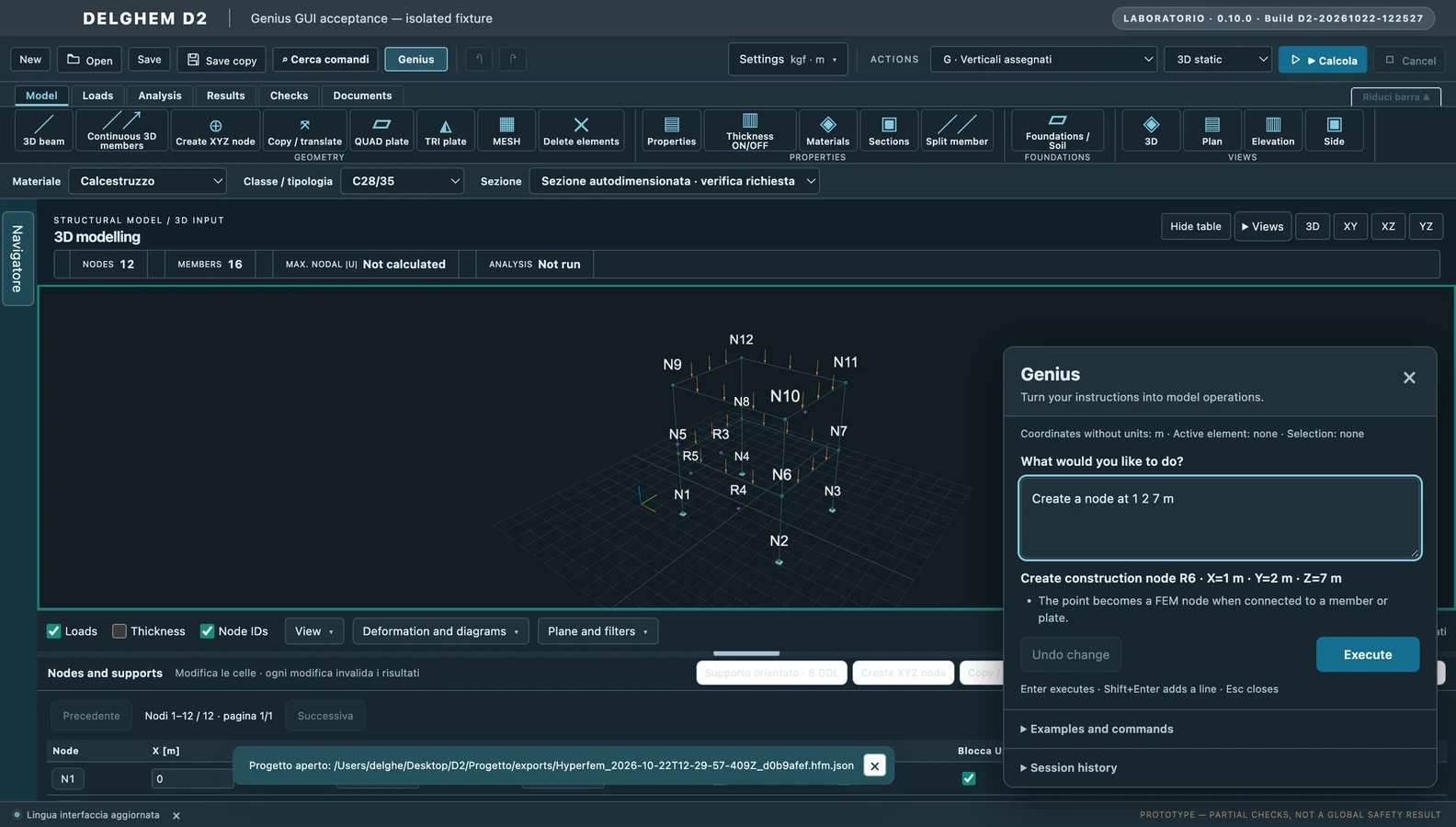
Genius is the natural-language engineering command pathway under development in DÈLGHEM D2. Rather than changing a structural model invisibly, it identifies the target entity, previews geometry or property changes, and leaves the engineer in charge of approval.
01 / TECHNICAL EVIDENCE
A textual instruction should produce an inspectable proposal
For example, Create a node at 0 0 4 specifies a geometrical location in model coordinates. The preview should identify the target and unit convention, and a node does not become a working finite-element mesh connection merely by existing. The model owner still verifies connectivity and duplicates.
The website demonstration offers deterministic example commands and a copy control, but does not execute modifications against a connected D2 project, generate new FEM results or pretend to replace structural engineering review.
02 / TECHNICAL EVIDENCE
Member properties, catalogues and load cases
The sample command Replace beam B4 with IPE400 S355 illustrates a coordinated change of a member’s section and steel grade. Catalogue presence, local section orientation and subsequent resistance checks must be examined before using such a model for design.
Node loads can also be expressed with signed force and moment components: Apply load Fz=-10 kN My=2 kNm to node N4 in case G. The preview documents intended units and the load case, but it does not independently verify the sign convention, combinations or structural capacity.
03 / TECHNICAL EVIDENCE
A model-aware workflow, not a generic chat response
Within the actual prototype, Genius is presented next to the modelling environment and property controls. The engineering workflow is instruction, interpretation, target preview, review, explicit confirmation and reversible changes. Ambiguous requests should not silently create undocumented geometry.
The interface remains under development. Pushover and IDA configuration examples are not evidence that nonlinear seismic workflows have all passed numerical qualification or that any particular building has been checked.
04 / TECHNICAL EVIDENCE
Native Apple Silicon application and publication status
DÈLGHEM is intended to run on ARM64 Apple Silicon macOS without requiring Windows virtualization. Native execution is a technological implementation choice, not a promise of a universal or unmeasured speedup. Real Kratos structural benchmarks are documented independently of the text-command UI.
vAlpha1 is a planned future development release, not a publicly available certified engineering application at this stage. Published screenshots are of the real D2 build, but do not constitute a certificate of completeness for the entire software.