Seismic base isolators versus viscous dampers: what changes?
Base isolation and viscous supplemental damping are not interchangeable design measures. Both can reduce particular components of seismic demand under appropriate assumptions, but they act on different dynamic properties. The DÈLGHEM website illustrates both concepts while distinguishing model demonstrations from completed engineering design.
Explore seismic device comparisons ↗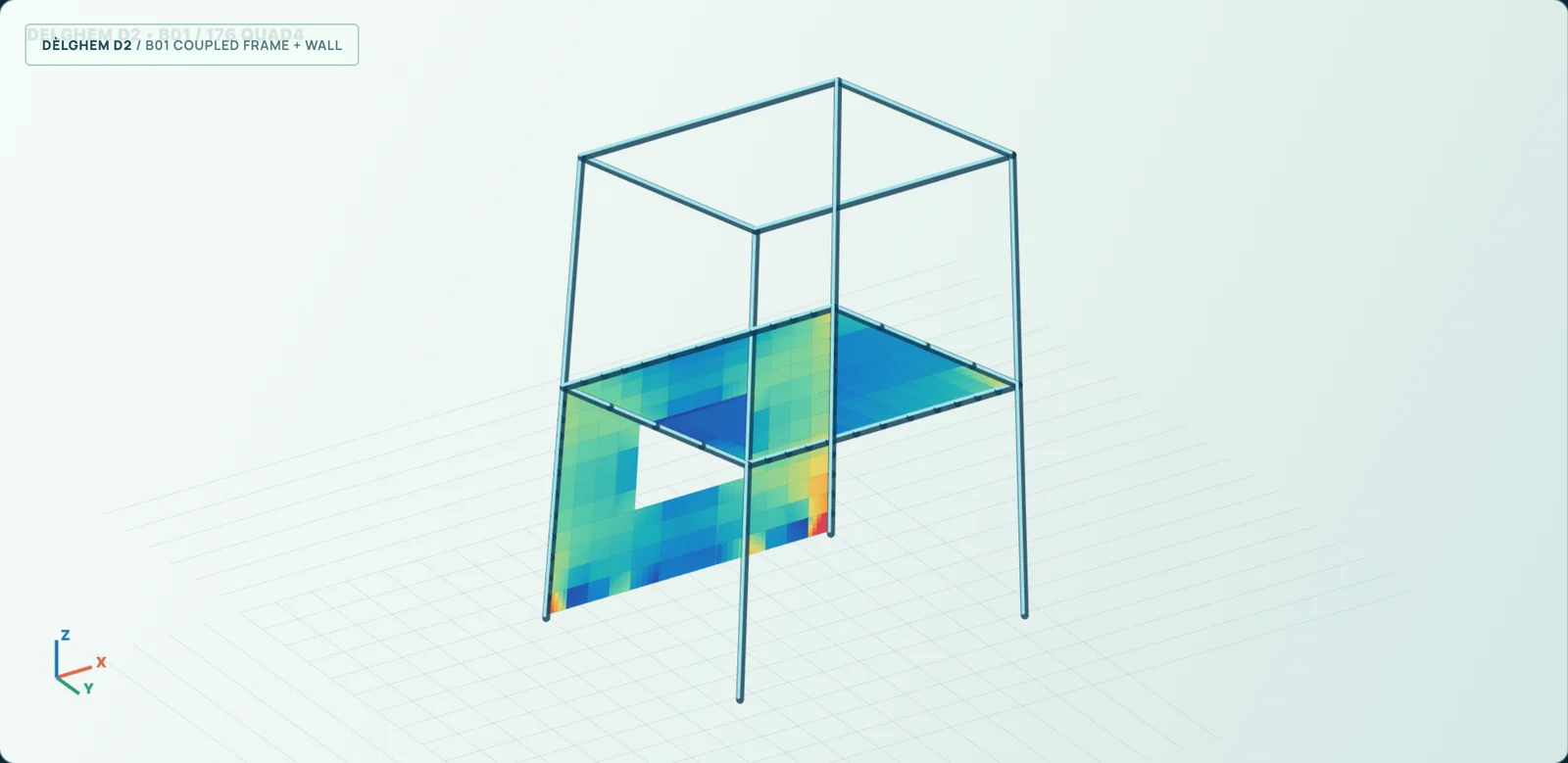
How seismic base isolation works
Base isolation modifies effective lateral stiffness and the structural period, concentrating much of the relative displacement within the isolation layer. Under appropriate ground motions this can reduce transmitted acceleration and force demands, but increases the importance of isolation-level displacement capacity. Results depend on device properties, damping and earthquake frequency content.
How viscous dampers change the response
A viscous device provides a force depending on relative velocity and device properties, often represented as F = C |v|^α sign(v). Supplemental energy dissipation may reduce response amplitudes but cannot guarantee reduced forces for every ground motion. Braces, attachments and load-transfer joints require separate strength and deformation checks.
Why force and displacement must be compared together
Demand comparisons should include member force envelopes, interstorey drifts, base movement and response histories rather than relying on a single coloured frame. A reduction in one demand component may create or expose demands elsewhere. Animations help interpret an assumed model, not certify earthquake-resilient performance.
From visual FEM comparison to real structural design
A useful engineering comparison requires common seismic input, declared mass and stiffness, device constitutive models, consistent boundary conditions and sensitivity checks. Project work further requires code compliance, qualified devices, connection detailing, displacement clearance and maintenance planning. The website demonstrations remain technical illustrations.
How to interpret animated demand comparisons
An animated frame is a useful visual explanation only when the displayed demand is tied to declared model input and compatible scales. A sound comparison should identify whether force envelopes are computed from a numerical time history, derived from an analytical approximation, or shown only schematically. The same ground acceleration and the same measurement conventions are needed to make statements about reduced demand. Otherwise different colours, legends or animation speeds can imply a performance advantage without proving it. The DÈLGHEM website therefore distinguishes visual interpretation from project-specific numerical verification.
Device checks required before engineering selection
Base isolation selection requires checks for maximum displacement, isolation-device shear strain and stability, transmitted acceleration and clearance for adjacent construction and services. For viscous dampers, an engineer must assess stroke, maximum force, temperature effects, attachment forces and device properties over the relevant frequency and velocity ranges. Both strategies require site-specific seismic input, valid combinations, model uncertainty assessment, qualified devices and maintainable construction details. The public comparison is a conceptual engineering demonstration and cannot replace analysis and checks for a particular building.
Frequently asked questions
Does base isolation eliminate seismic forces?
No. It modifies dynamic transmission and demand; engineering verification is still necessary.
Do viscous dampers always reduce every force?
No. Response depends on the ground motion, modelling assumptions, stiffness, damping and device location.
Technical material from DÈLGHEM D2 development; software, design outputs and individual checks remain subject to validation. vAlpha1 release planned for January 2027.