FINITE ELEMENT ANALYSIS / SOLVER OUTPUT
3D FEM stress contours computed on QUAD4 shells
A source-backed DÈLGHEM D2 benchmark with 176 finite shell elements, 66 coupled beam segments, a slab and a structural wall with an opening. Stress fields are based on actual KratosMultiphysics static results at integration points, with their interpretation limits disclosed.
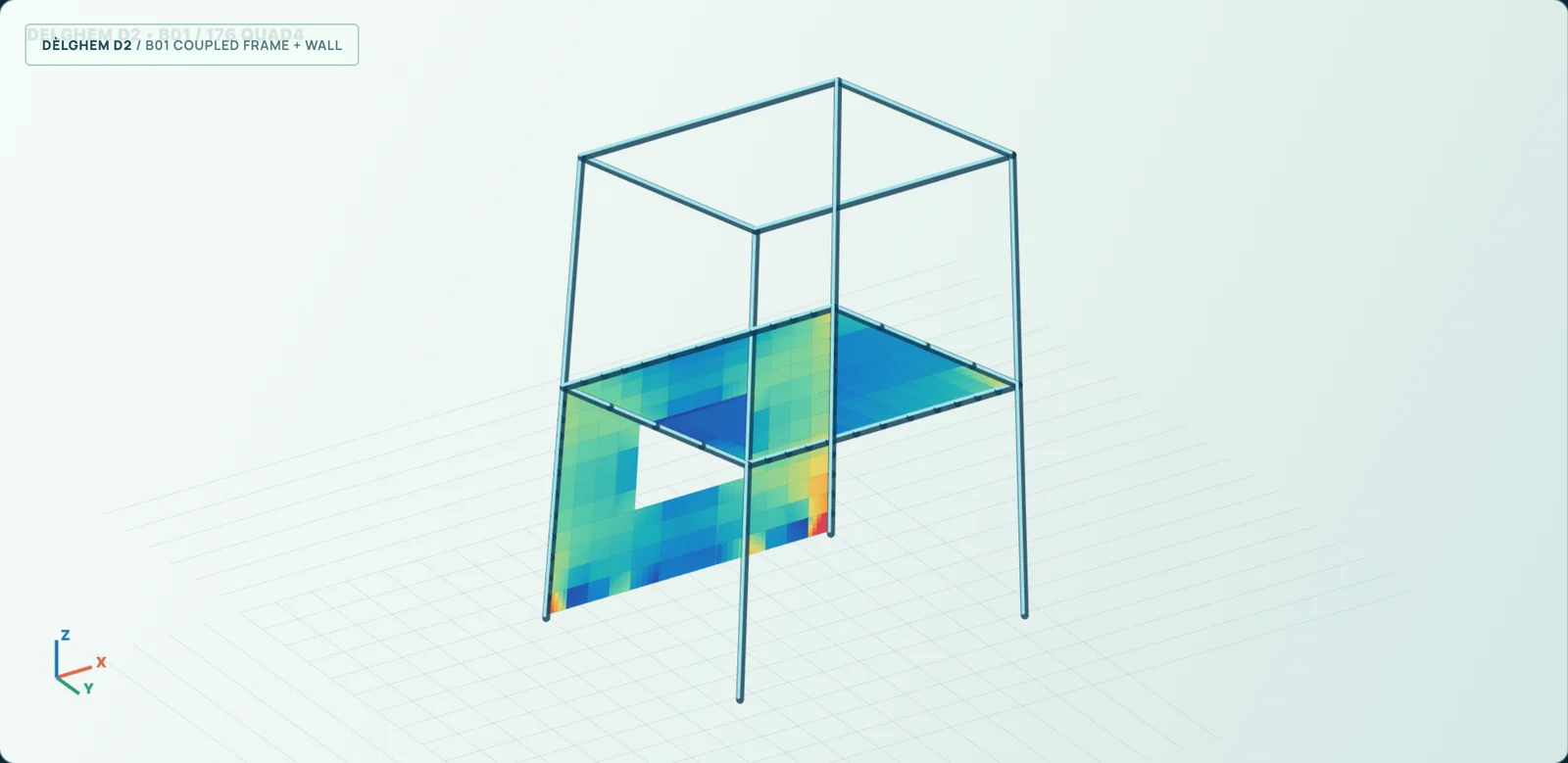
From a structural model to finite elements
A finite-element model replaces a complex continuum with discrete interconnected elements. Shell elements are appropriate for representing plate-like surfaces, structural walls, floor plates and other regions when the selected formulation matches the physical problem. Accurate interpretation depends on the load cases, constraints, material parameters and mesh quality.
The DÈLGHEM B01 visual benchmark is an irregular spatial frame incorporating a reinforced-concrete wall with an opening, a coupled slab and beam members. The analysis uses 176 QUAD4 shells and 66 beam segments. These entities belong to the native computational model; their presence is not an aesthetic mesh added solely to a promotional illustration.
Von Mises and local face stresses
The elastic recovery of native Kratos membrane force and bending moment resultants exposes σ11, σ22, τ12 and equivalent Von Mises stress. Components are expressed in MPa and can be examined on the upper or lower shell face. A large magnitude does not, by itself, classify the element as compliant or non-compliant with a design code.
For each QUAD4 element Kratos returns membrane forces and bending moments at four Gauss integration points. For this isotropic elastic case the website recovers local face stresses as N/h ± 6M/h² in MPa. The viewer interpolates those reconstructed values inside the original element for clearer colors, without claiming a validated nodal field. The relationship between local axes, shell orientation and displayed face is essential when comparing stress components.
Equilibrium residual is not a safety certificate
For this particular static benchmark, KratosMultiphysics reports an equilibrium residual around 8.2×10⁻¹². This is a solver-specific convergence measure for the actual analyzed input, not a proof that a construction project is safe. A converged result can still be based on erroneous supports, unrepresentative materials or missing load conditions.
A meaningful engineering review also checks deformation shapes, load transfer, sign conventions, boundary conditions, discretization sensitivity and the relationship between numerical response and design limits. Results should be checked against independent solutions whenever the application domain warrants it.
Exploring the interactive 3D response
The on-page Canvas viewer lets visitors orbit the spatial model, reveal the shell mesh, switch stress components and select individual panels. A visually amplified deformed configuration is included to help understand the structural mode of response, with the display factor clearly separated from the numerical displacement. The steel frame and concrete wall are rendered with distinct materials.
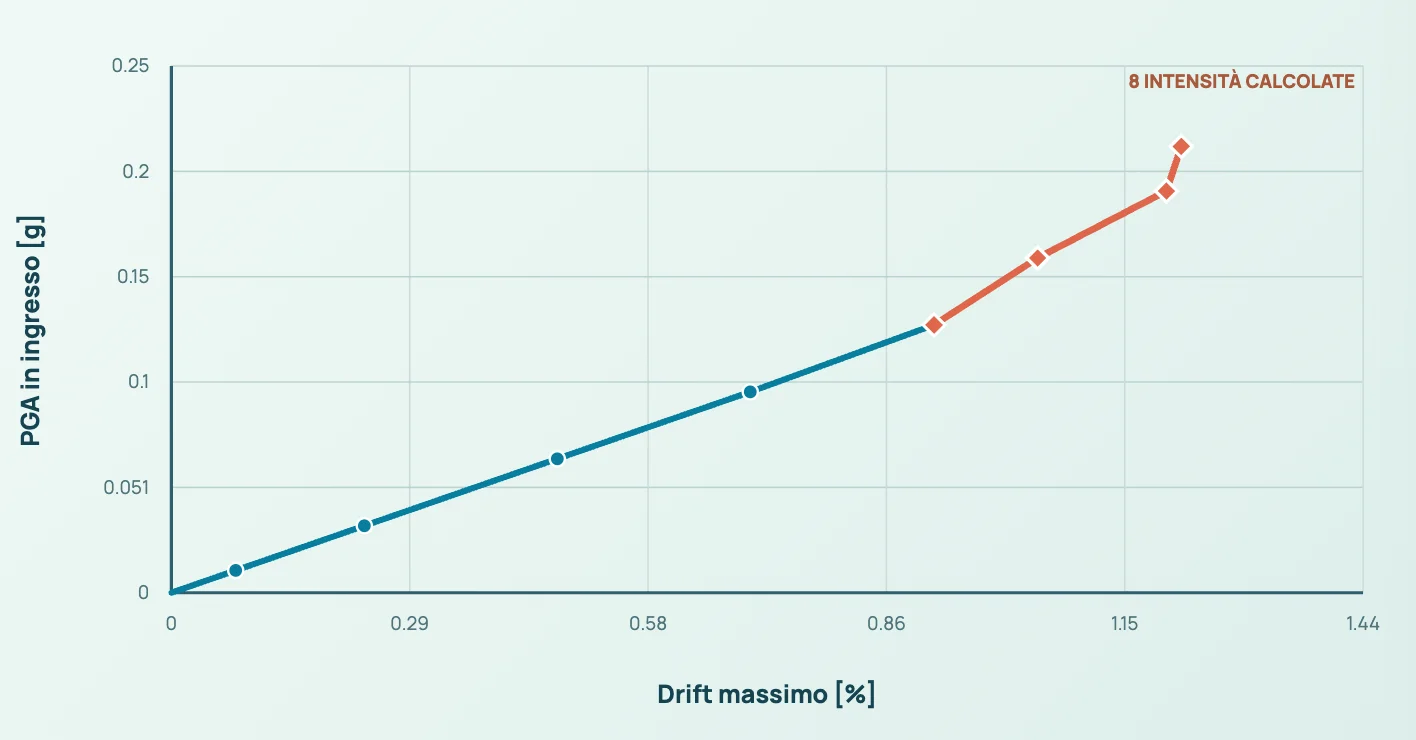
The interactive FEM Lab shows the underlying stress components and colors. An independent pair of steel-fiber nonlinear Pushover and IDA benchmarks demonstrates post-yield behavior without implying that it is computed for this shell example.
Distinct from the eight-storey homepage geometry
The opening visualization on the DÈLGHEM website is a native eight-storey model with S355 steel, C30/37 concrete, GL24h roof trusses and pad footings. It is validated as an editable D2 input geometry, not as a completed design calculation. The stress-contour analysis described on this page refers to the separate B01 test case.
Clearly separating a model showcase from a solved numerical benchmark prevents a colorful structural animation from being mistaken for approved professional analysis. DÈLGHEM vAlpha1 remains in active development, with a provisional January 2027 release target and qualification work still in progress.
Frequently asked questions
Does a red area imply an unsafe or failing element?
No. The map expresses stress magnitude in MPa, not a direct design resistance or utilization comparison.
Are the stresses artificial colors?
Colors are a visualization of local face stresses recovered from genuine D2/KratosMultiphysics Gauss-point membrane forces and moments, not arbitrary values.
Does this stress map belong to the homepage eight-storey tower?
No. It belongs to a different solved B01 benchmark with 176 QUAD4 shell elements.