Structural material takeoff from an FEM model
A structural material takeoff should be traceable back to the model members and their properties. The DÈLGHEM D2 demonstration uses nodes, section properties and material assignments from a separate eight-storey mixed structural model. Displayed figures derive from source input—not an invented marketing chart.
Open the interactive material takeoff ↗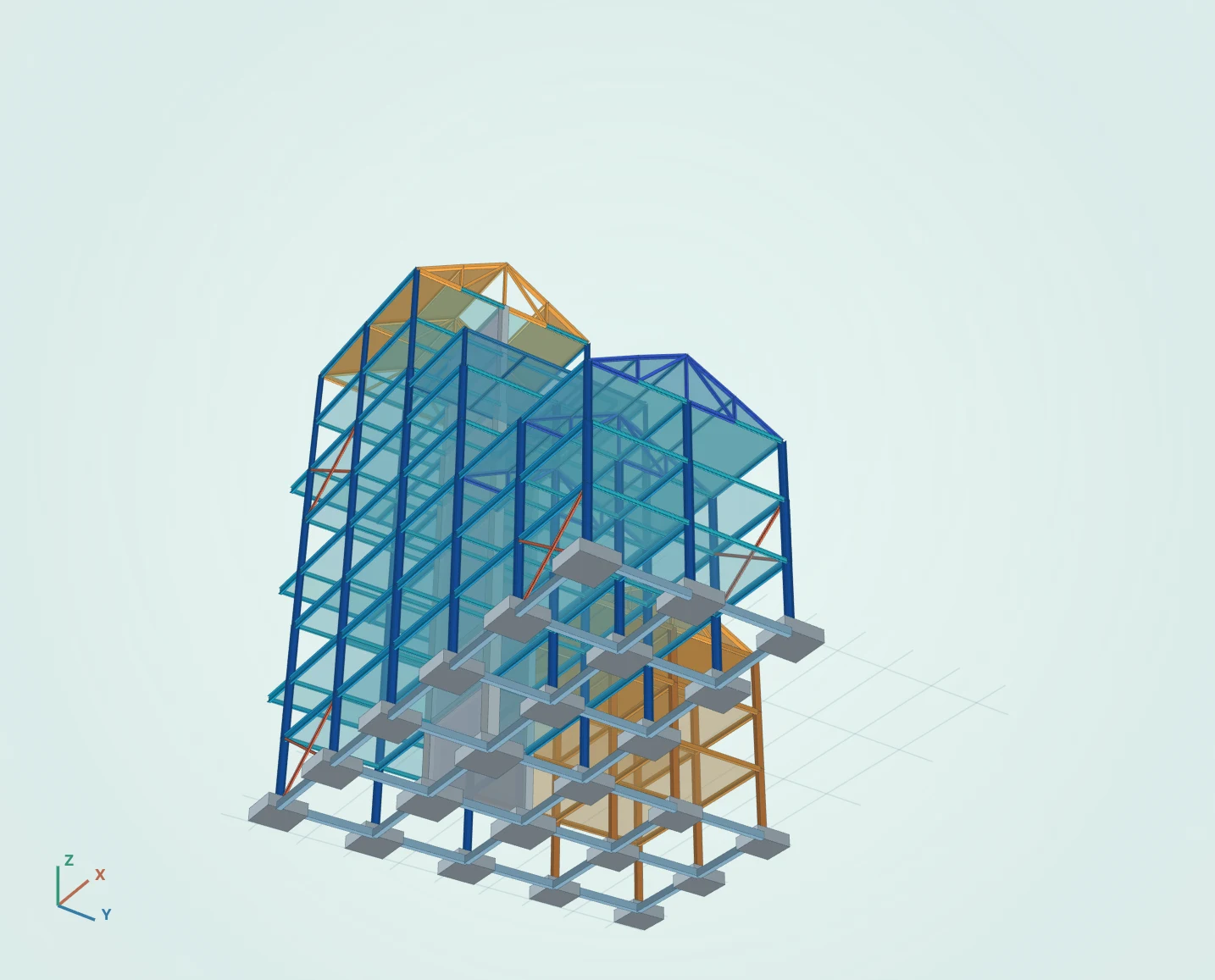
Member lengths and volumes
Each member centreline length is computed from its two end nodes and multiplied by the assigned section area: L = √[(Δx)²+(Δy)²+(Δz)²], V = L × A. The resulting quantities are grouped by material. Equivalent mass uses the model weight density with an explicit kN-to-kg conversion. Aggregates can be inspected and exported as CSV.
Plates and shells: separate quantities
The same source model contains 112 surface elements. Their takeoff is not silently merged into the member subtotal. Polygonal areas are derived from model vertices, and volumes are obtained by multiplying each area by its specified thickness. Openings, intersections, overlaps and construction wastage are not yet deducted.
Reinforcement schedules belong to a different case study
A distinct D2 reinforced-concrete DXF archive contains 87 A1 sheets with a total recorded reinforcement mass of approximately 5,239.49 kg. This is not part of the eight-storey mixed-frame takeoff. Keeping the sources separate avoids double counting and misleading totals.
From measured quantities to a priced bill of quantities
A model-derived material takeoff is not a contractual cost estimate. Proper pricing requires project-specific work items, valid unit-price references, fabrication allowances, wastage, transport and independent engineering checks. This demonstration provides preliminary quantities, not fabricated procurement costs.
A reproducible quantity-audit workflow
The demonstrator makes both the model-derived JSON and a CSV schedule available for inspection. For a particular member, the source provides its identifier, start and end nodes, section area and assigned material. Its centreline length and volume can therefore be recomputed independently from the geometry. Shells require a separate calculation based on face vertices and assigned thickness instead of the beam length formula. This chain of evidence is especially useful during revisions: engineers can distinguish changes in source geometry from presentation rounding or a later change to takeoff assumptions.
What is not counted by a preliminary FEM quantity model
A structural analytical model is not necessarily identical to construction geometry. Beam centrelines intersect, floor slabs can contain openings, steel fabrication may require plates and welds, and reinforcement schedules may have laps, cut lengths and discarded portions. A procurement bill must define measuring rules, deductions, local price items, fabrication allowances and procurement units before translating analytical quantities into budgets. The public DÈLGHEM schedule intentionally omits these unsupported refinements and preserves a separate reinforced-concrete DXF case instead of incorrectly merging materials from different structural studies.
Frequently asked questions
Are the quantities computed or invented?
They derive from D2 model geometry and element properties, with exclusions disclosed.
Does the takeoff contain prices?
No. It is a preliminary quantity schedule, not a priced bill of quantities.
Technical material from DÈLGHEM D2 development; software, design outputs and individual checks remain subject to validation. vAlpha1 release planned for January 2027.